Ever wished your party invitations looked like an official Hogwarts acceptance letter? Or perhaps you're designing a fan project, a website, or even a book report, and you want to infuse it with the authentic, enchanting spirit of the Wizarding World. If you've ever found yourself pondering how to bring that magic to your text, you're in the right place. This guide is your Marauder's Map to downloading & installing Harry Potter style fonts, transforming your mundane typography into something truly spellbinding.
Forget struggling with generic fonts that lack that certain je ne sais quoi. We’ll cover everything from finding the perfect font to wielding it confidently across your creative projects, all while ensuring your choices are both practical and perfectly aligned with the spirit of the series.
At a Glance: Your Quick-Reference Spellbook
- Find Your Magic: Discover a rich collection of Harry Potter-inspired fonts, from iconic movie logos to character-specific handwriting.
- Commercial Freedom: Most popular Harry Potter style fonts are free for both personal and professional use, requiring no license or attribution.
- Simple Downloads: Learn how to quickly find and download font files, usually packaged in convenient ZIP archives.
- Effortless Installation: Get step-by-step instructions for installing new fonts on Windows, Mac, and even how to integrate them into your favorite design software.
- Creative Cautions: Understand best practices for font pairing, ensuring legibility, and avoiding common pitfalls to keep your designs enchanting, not chaotic.
- Troubleshooting Charms: Quick fixes for when a font doesn't appear or acts stubbornly.
Why Cast a Font Spell? The Allure of Harry Potter Typography
The Harry Potter universe isn't just about stories; it's a meticulously crafted world where every detail, down to the very letters on a page or screen, contributes to its immersive charm. Think of the jagged, almost ancient script of the original book titles, the elegant flourishes of a Hogwarts professor's notes, or the ominous, scratched warnings in the Chamber of Secrets. These aren't just fonts; they're integral parts of the narrative, instantly evoking specific moods, characters, and iconic moments.
For fans and creators alike, using Harry Potter style fonts allows you to extend that magic into your own endeavors. Whether you're crafting fan art, designing event invitations, creating unique merchandise, or simply personalizing a document, these fonts act as a visual shortcut, instantly signaling "Wizarding World ahead!" What's truly fantastic about the most popular collections is their accessibility: many of these typefaces are commercially free, meaning you won't need to worry about licenses or attribution for either personal or professional projects. This freedom unlocks a vast cauldron of creative possibilities.
Unpacking the Cauldron: Understanding Harry Potter Font Types
The term "Harry Potter style fonts" isn't just one font; it's a treasure trove of typefaces, each inspired by a distinct element of J.K. Rowling's universe. These fonts capture the spirit of the books and films, offering a range of styles from the grand and official to the quirky and character-driven. Let's delve into some of the most beloved and widely available types you'll encounter.
Official Logos & Cinematic Styles
These are the fonts that immediately transport you to the movie screen or the cover of a beloved book. They often replicate the iconic title treatments and stylistic choices seen in official media.
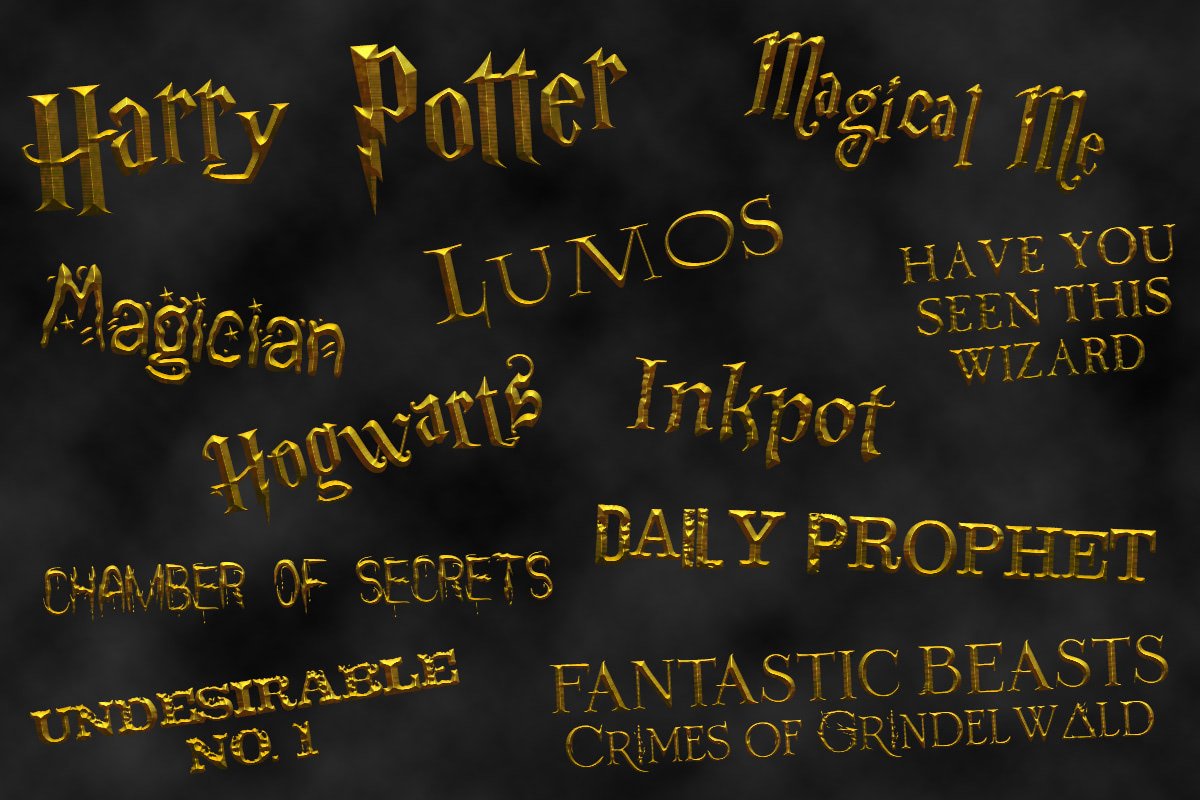
- Harry P: This is often the first font people seek. It’s a direct recreation of the earliest and most recognizable Harry Potter film logo, heavily inspired by Mary GrandPré's iconic American book covers. It’s the quintessential "Harry Potter" look.
- Lumos: Inspired by the chapter titles in the US editions of the Harry Potter books, Lumos often includes charming symbols like brooms or the Golden Snitch, perfect for adding those little magical touches.
- Fantastic Beasts & Crimes of Grindelwald: If your project leans towards the prequel series, these fonts capture the distinct logo styles of the Fantastic Beasts films. Crimes of Grindelwald, for instance, might even include unique glyphs, like an Elder Wand symbol, to perfectly mimic the film's title card.
- It All Ends Here (Harry Potter 7): Evoking the dramatic slogan used for Deathly Hallows: Part 1 & 2, often reminiscent of the burning Hogwarts Castle posters, this font carries a heavier, more impactful feel.
Handwriting & Character Voices
Some of the most engaging Harry Potter fonts capture the unique scrawl or distinctive text of specific characters or in-universe documents. They add a personal, often playful or ominous, touch.
- Magical Me (Parry Hotter): Remember Gilderoy Lockhart's self-aggrandizing autobiography? This font captures that flamboyant, slightly ostentatious style, perfect for anything needing a touch of comical vanity.
- Hagrid: Big, bold, and a little rough around the edges, this font truly looks like Rubeus Hagrid himself penned it. Ideal for messages with a hearty, rustic feel.
- Have You Seen This Wizard: Instantly recognizable from Sirius Black's "wanted" posters in Prisoner of Azkaban, this font is fantastic for creating dramatic, weathered, or even slightly distressed text.
- It’s Scary Now: For those darker, more mysterious projects, this font channels the unsettling blood-written messages from Chamber of Secrets, perfect for a chilling effect.
- Scratched Handwriting: Inspired by Harry's infamous "I MUST NOT TELL LIES" punishment by Dolores Umbridge, this font offers a distressed, almost painful aesthetic, great for conveying discomfort or constraint.
- Beedle the Bard: This font beautifully mimics the ancient, storybook-like script from Hermione Granger's copy of The Tales of Beedle the Bard, lending an air of tradition and storytelling.
Enchanting Elements & Thematic Designs
Beyond direct reproductions, many fonts capture the overall vibe of the Wizarding World, incorporating magical flourishes, medieval touches, or specific in-universe elements.
- Parseltongue: This font is literally inspired by the snake language in the Harry Potter universe. Using it immediately signals a sinister or ancient magical presence, ideal for very specific, evocative design choices.
- Undesirable No. 1: Drawing from the propaganda posters in Deathly Hallows, this font has a stark, almost totalitarian feel, great for conveying a sense of oppression or official decree.
- The Daily Prophet: Replicates the distinctive masthead or article text from the wizarding newspaper, perfect for creating mock-ups or designs that feel like they're ripped from the pages of the Prophet itself.
- Educational Decree: Directly inspired by Dolores Umbridge’s oppressive proclamations in Order of the Phoenix, this font carries an authoritarian, almost bureaucratic elegance, often with sharp serifs.
- Aquiline & Inkpot: These cursive or stylized fonts evoke the classic quill-and-parchment aesthetic, perfect for formal letters, invitations, or any text meant to appear handwritten by a wizard.
- Magic School, Magik, Magician: These are broader "Harry Potter style" fonts, often featuring lightning bolt motifs, whimsical curls, or a general sense of arcane wonder, adding a magical touch to any project.
- Golden Snitch & Dingbats: Some creative font collections include "dingbat" fonts. These aren't text in the traditional sense, but rather a set of characters that, when typed, produce symbols like a Golden Snitch, various character logos, or book cover elements. They are fantastic for adding quick, recognizable icons to your designs.
The sheer variety means you'll almost always find a font that perfectly aligns with the specific mood or message you want to convey.
Your Spellbook for Success: How to Download Harry Potter Fonts
Finding and downloading fonts is generally a straightforward process, but knowing where to look and what to do next is key. Think of it as gathering your magical ingredients before brewing a potion.
Finding Reputable Font Vaults
The vast majority of Harry Potter style fonts are created by talented fan designers and shared freely online. Because they are often derived from existing copyrighted material (like movie logos or character handwriting), they fall into a grey area for commercial creation by the original artists. However, the ground truth confirms that the most widely distributed Harry Potter font collections are generally free for commercial use, requiring no license or attribution. This is excellent news for anyone looking to use them in professional projects, personal crafts, or anything in between.
Popular font repositories and fan sites are your best bet. A quick search for "Harry Potter fonts free download" will lead you to several well-known platforms. Always prioritize sites that look professional, have clear download buttons, and offer direct access to font files rather than requiring you to navigate multiple ad pages.
The Download Process: Unzipping the Magic
Once you've found your chosen font (or a whole collection!), downloading is usually as simple as clicking a button. Here's what to expect:
- Click to Download: You’ll typically click a "Download" button.
- ZIP File Delivery: Most fonts, especially if you're downloading a collection, will come packaged in a
.zipfile. This compressed folder keeps all the font files together and makes downloading quicker. - Extracting Your Spell Components: Before you can install or use the fonts, you need to "extract" them from the ZIP file.
- On Windows: Right-click the
.zipfile, then select "Extract All..." Choose a destination folder (your Downloads folder is fine, or create a new "Harry Potter Fonts" folder), and click "Extract." - On Mac: Simply double-click the
.zipfile. macOS will automatically create a new folder with the same name, containing your extracted font files, typically in the same location as the ZIP file.
- Identifying Font Files: Inside the extracted folder, you'll find the actual font files. They usually have
.ttf(TrueType Font) or.otf(OpenType Font) extensions. These are the files you’ll install.
Want to try out different Harry Potter fonts before you commit to downloading and installing them all? You might find it useful to experiment with an online tool that lets you generate text with various styles. Check out this Harry Potter font generator to quickly preview how your words will look in different magical typefaces.
Wand Practice: Installing Your New Fonts
Once you've extracted your .ttf or .otf files, the next step is to install them on your operating system. This makes them available for use in almost any application on your computer, from word processors to graphic design software. The process is slightly different depending on whether you're a Windows or Mac user.
For Windows Users: A Quick Enchantment
- Locate Your Font Files: Navigate to the folder where you extracted your
.ttfor.otffiles. - Select & Install: You have a couple of options:
- Option A (Quick Install): Right-click on the desired font file(s) and select "Install." Windows will quickly install them, making them available system-wide.
- Option B (Font Viewer/Manager): Double-click a font file. This opens a preview window. At the top of this window, you’ll see an "Install" button. Click it. This is useful if you want to preview a font before committing to installing it.
- Install Multiple Fonts: To install several fonts at once, select all the font files you want to install (hold
Ctrland click each one, or drag a selection box), then right-click any of them and choose "Install." - Restart Applications: For the new fonts to appear in your applications (like Microsoft Word, Photoshop, etc.), you might need to close and reopen those programs after installation. Some programs may require a full system restart, though this is less common for fonts.
For Mac Users: Brewing Up New Typefaces
- Locate Your Font Files: Open the folder containing your extracted
.ttfor.otffiles. - Double-Click to Preview: Double-click on a font file. This will open "Font Book," Apple's built-in font management utility, showing you a preview of the typeface.
- Install Font: In the Font Book window, click the "Install Font" button at the bottom right.
- Validate & Resolve (if needed): Font Book will perform a quick validation check. If there are any issues (like a corrupted file or a duplicate), it will alert you. Most of the time, fonts from reputable sources install without a hitch.
- Install Multiple Fonts: Select multiple font files (hold
Commandand click each one, or drag a selection box), then right-click and choose "Open With" > "Font Book." Or, simply drag the selected files directly into the Font Book application window or its icon in the Dock. - Restart Applications: Just like on Windows, you might need to close and reopen any applications you plan to use the new fonts in for them to appear in the font list.
For Linux Users: A Bit of Command-Line Magic (or GUI)
Linux distributions typically offer both command-line and graphical ways to install fonts.
- GUI Method (Easier): Many desktop environments (like GNOME, KDE Plasma) allow you to simply double-click a
.ttfor.otffile. This will open a font viewer that usually has an "Install" button. Click it, and the font will be installed. - Manual Method:
- Create a
.fontsdirectory in your home directory if it doesn't exist:mkdir -p ~/.fonts - Copy your
.ttfor.otffiles into this directory:cp /path/to/your/fontfile.ttf ~/.fonts/ - Update the font cache:
fc-cache -fv - Restart applications.
Using Fonts in Specific Design Software
While installing fonts on your operating system makes them globally available, some professional design applications (like Adobe Photoshop, Illustrator, Figma, or Canva) might have their own ways of handling fonts, especially for cloud-based or web-specific projects.
- Desktop Software: For most desktop design software, once the font is installed system-wide, it will appear in the application's font list after restarting the program.
- Web Projects: For web design, you can't just install a font on your computer and expect it to appear on others' browsers. You'll need to use CSS
@font-facerules to embed the font files directly into your website. This involves hosting the.ttf,.woff, or.woff2versions of the font and linking to them in your stylesheet. - Online Design Tools (e.g., Canva): Some online tools allow you to upload custom fonts directly into their platform for use in your projects. Look for an "Upload font" or "Brand kit" option within the platform's settings.
Casting Wisely: Best Practices & Creative Considerations
Having access to a magical array of fonts is one thing; using them effectively is another. Just as a wizard carefully chooses their spells, you should thoughtfully select and apply your Harry Potter fonts for maximum impact and readability.
Licensing & Usage: The Unbreakable Vow of Font Ethics
As mentioned, a huge advantage of many Harry Potter style fonts is their commercial freedom. The ground truth confirms they are typically "bebas secara komersial, tidak memerlukan lisensi atau atribusi, cocok untuk penggunaan pribadi maupun profesional." This means:
- No Royalties, No Fees: You won't have to pay to use these fonts.
- Attribution Not Required: You generally don't need to credit the font designer, though a polite nod is always appreciated if you know who created it.
- Personal and Professional: Whether you're making a birthday card for a friend or designing marketing materials for your business, these fonts are fair game.
A Word of Caution: While most community-created Harry Potter fonts are free for all, always double-check the download page or any included license file when acquiring fonts from less familiar sources. If a font is explicitly labeled "for personal use only," respect that. Misusing fonts can lead to legal complications, though this is rare with the widely distributed HP fan fonts.
Pairing Fonts for Maximum Magic
Using too many different fonts can make your design look cluttered and unprofessional – like a potions class explosion. The key is to select a primary "Harry Potter" font for headlines or key elements and then pair it with a complementary, more readable font for body text or secondary information.
- Contrast is Key: If your Harry Potter font is ornate and decorative (e.g., Harry P, Aquiline), choose a clean, simple sans-serif or a subtle serif for accompanying text. This ensures readability.
- Example: Use Harry P for a party invitation heading, then a clear, elegant serif font like Georgia or a modern sans-serif like Montserrat for the party details.
- Subtle Echoes: Sometimes, you can pair two HP-style fonts if they complement each other. For instance, The Daily Prophet for a headline could be paired with a slightly simpler, traditional serif font for article body text within the same design.
- Function Over Flash: Always prioritize legibility for the main body of your text. A highly stylized font that’s hard to read will detract from your message, no matter how magical it looks.
Common Pitfalls: Avoiding Design Dementors
- Overuse: Don't use Harry P for every single word on a page. It loses its impact and quickly becomes overwhelming. Reserve your most dramatic fonts for headlines, logos, or short, impactful phrases.
- Illegibility: Some highly decorative fonts, while beautiful, can be difficult to read at small sizes or in long blocks of text. Test your chosen font at various sizes and on different backgrounds to ensure it remains clear.
- Inconsistent Theme: Ensure your font choices align with the overall mood of your project. Using a spooky It’s Scary Now font for a cheerful birthday invitation might send the wrong message.
- Ignoring Spacing (Kerning & Leading): Some custom fonts might have default spacing that looks a bit off. Be prepared to adjust kerning (spacing between individual letters) and leading (spacing between lines of text) in your design software to ensure optimal readability and aesthetic appeal.
Troubleshooting Charms: When Your Font Vanishes
Even the most seasoned wizards occasionally encounter a tricky spell. If your newly installed Harry Potter font isn't appearing or behaving as expected, don't panic. Here are some common issues and their quick fixes.
"My Font Isn't Showing Up!"
This is the most frequent issue.
- Restart Applications: The number one culprit. Most applications load available fonts when they start. If the application was open during the font installation, it likely won't see the new font until you close it completely and reopen it.
- Check Installation: Double-check that the font was indeed installed correctly.
- Windows: Go to
Settings > Personalization > Fonts(orControl Panel > Fontson older versions). You should see your new font listed there. - Mac: Open "Font Book" and search for the font by name.
- Verify File Type: Ensure you installed
.ttfor.otffiles, not the original.ziparchive or any other extraneous files. - Correct Name: Are you searching for the correct font name in your application? Sometimes the internal font name differs slightly from the filename. Check the font name displayed in the Windows Font settings or Mac Font Book.
Corrupted Files & "Font Not Valid" Errors
Occasionally, a downloaded font file might be damaged or poorly created, leading to installation errors or rendering issues.
- Redownload: Delete the problematic font file and try downloading it again from the original source.
- Try an Alternative Source: If the issue persists, the file itself might be corrupt on that specific download site. Try finding the same font from a different reputable font repository.
- Font Book Validation (Mac): Font Book is good at flagging invalid fonts during installation. If it identifies issues, it might give you options to resolve them or instruct you to discard the font.
Compatibility Issues
While rare for standard .ttf and .otf files, very old or obscure font formats might not be universally compatible.
- Outdated Formats: If you encounter a
.fonor other less common font format, it might not work with modern operating systems or applications. Stick to.ttfand.otffor best compatibility. - Application-Specific Problems: Very occasionally, a specific application might have trouble rendering a particular font, even if it's installed system-wide. This is often an isolated bug. Try using the font in a different application to see if the problem is localized.
Your Next Magical Project Awaits
With your newfound knowledge of downloading & installing Harry Potter style fonts, you're now equipped to infuse a touch of the Wizarding World into virtually any creative endeavor. From crafting personalized stationery that would make Minerva McGonagall proud, to designing fan websites, or even just adding a bit of magic to your digital scrapbooks, the possibilities are as boundless as the Room of Requirement.
Remember to choose your fonts thoughtfully, pair them wisely, and always prioritize readability. Experiment with the vast array of styles—from the grandiosity of film logos to the intimate scrawl of character handwriting—and let your imagination guide your wand (or mouse, in this case!). The magic of typography is at your fingertips; go forth and create something truly enchanting.