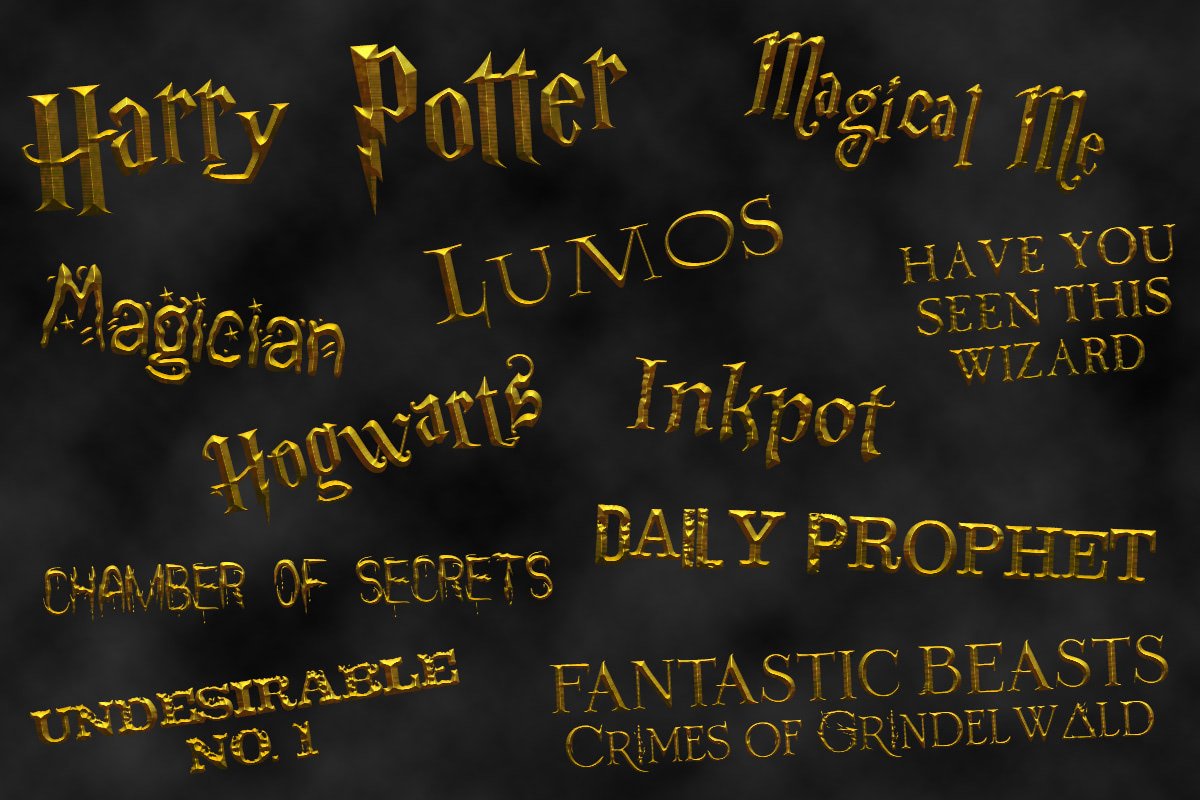
Stepping into the magical realm of Harry Potter through design is incredibly tempting. Those iconic fonts, evocative of ancient scrolls, wanted posters, or even a mischievous scrawl from Hagrid, offer an instant connection to a beloved universe. But before you wave your design wand and conjure up your next project, there's a critical spell you need to learn: the intricacies of Licensing & Copyright for Harry Potter Themed Fonts. Navigating this landscape isn't just about legality; it's about respect for creators, protecting your own work, and avoiding a trip to the Ministry of Magic's legal department.
This isn't light reading; it's your definitive guide to understanding how intellectual property laws intersect with the enchanting world of Harry Potter typefaces. Get it wrong, and your creative freedom could vanish faster than a snitch. Get it right, and you can design with confidence, knowing you're on solid ground.
At a Glance: Key Takeaways
- "Free" ≠ "Free for Commercial Use": Most Harry Potter-inspired fonts are fan-made and free for personal use, but commercial use almost always requires a license or specific permission.
- Copyright vs. Trademark: Font software can be copyrighted, but the names, characters, and stylistic elements like the Harry Potter lightning bolt logo are trademarked by Warner Bros.
- Always Check the EULA: Every font comes with an End User License Agreement. Read it carefully to understand permitted uses.
- Fan Art vs. Infringement: While fan art exists, selling products that use trademarked or copyrighted elements without permission is infringement.
- The Risks Are Real: Unauthorized commercial use can lead to cease and desist letters, lawsuits, and significant financial penalties.
- When in Doubt, Don't: If you can't verify clear commercial rights, choose an alternative or seek legal counsel.
The Allure of the Wizarding World: Why Fonts Cast Such a Powerful Spell
From the moment you first saw "Harry P" recreate the iconic film logo, inspired by Mary GrandPré’s American book cover, or encountered the distinct script of "Lumos" mirroring the US book chapter titles, you felt it: fonts are integral to the Harry Potter experience. They don't just convey words; they convey atmosphere, character, and story.
Imagine trying to evoke the chilling warnings from Harry Potter and the Chamber of Secrets without a font like "It’s Scary Now" based on the writing-in-blood, or crafting a playful design without "Golden Snitches" adding whimsical elements around your text. These typefaces—whether they’re the rugged "Hagrid" mirroring Rubeus Hagrid’s scrawling hand or the bold "UNDESIRABLE NO. 1" echoing Sirius Black’s wanted posters—are design gold. They draw us deeper into the narrative, making us feel like we're truly part of the Wizarding World.
This powerful connection is precisely why these fonts are so desirable for creators. They add authenticity, charm, and instant recognition. But with great magical power comes great legal responsibility.
The Core Challenge: Navigating IP in the Wizarding World
The primary hurdle when using Harry Potter-themed fonts is the clash between passion (your desire to create) and proprietary rights (Warner Bros.' ownership of the Wizarding World). While you might find a font called "Parseltongue" to mimic the snake language or "Educational Decree" to replicate Dolores Umbridge’s proclamations readily available for download, their very names and designs leverage established intellectual property.
It's a nuanced situation because we're often dealing with two distinct layers of intellectual property:
- The Font Software Itself: The digital file (
.ttf,.otf) that allows your computer to display the characters. This software is often copyrighted by the font designer. Many fan-made fonts are offered for "free" by their creators, often with a personal use license. - The Underlying Intellectual Property: This includes character names, settings, specific visual designs (like the Elder Wand glyphs in "Crimes of Grindelwald"), logos (like the "Fantastic Beasts" logo typeface), and unique stylistic elements that evoke the Harry Potter universe. These are largely protected by trademark and copyright held by Warner Bros. Entertainment Inc. and J.K. Rowling.
So, while a fan-created font like "Harry Potter 7 (It All Ends Here)" might be "free" to download from a font website, using it commercially could still infringe on Warner Bros.' rights to the "Harry Potter 7" tagline, the imagery of Hogwarts Castle, or even the overall trade dress of the film series. This distinction is crucial and often misunderstood.
Understanding the Pillars: Copyright, Trademark, and Licensing
To responsibly use Harry Potter-inspired fonts, you need a firm grasp of the legal foundations: copyright, trademark, and licensing. Think of them as the three unforgivable curses you don't want to cast on your design career.
Copyright Explained: Protecting the Expression
Copyright law protects original works of authorship fixed in a tangible medium. For fonts, this usually applies to the font software—the code that makes the typeface work. The actual design of individual letterforms, however, is generally not protected by copyright in the U.S. (though it can be in other countries, and sometimes specific, highly artistic designs can qualify).
This means a designer can create a digital font that looks similar to the "Beedle the Bard" lettering from Hermione Granger’s book, and copyright the software for that new font. But the concept of "Beedle the Bard" lettering, or the specific "Beedle the Bard" title, is likely protected by Warner Bros. This is where trademark comes in.
Trademark Explained: Protecting Brand Identity
Trademark law protects words, names, symbols, sounds, or colors that distinguish goods and services of one party from those of others. Warner Bros. holds numerous trademarks related to the Harry Potter universe, including names like "Harry Potter," "Hogwarts," "Gryffindor," character names, and distinct logos and visual elements.
When you use a font like "Magical Me (Parry Hotter)" or "Have You Seen This Wizard" for a commercial product, you're not just using a font; you're leveraging the brand recognition and associations of Gilderoy Lockhart’s autobiography or Sirius Black's wanted posters. Even if the font itself is technically "free," its use in a commercial context creates a likelihood of confusion among consumers, suggesting an affiliation with or endorsement by Warner Bros. This is a trademark infringement. The same goes for fonts designed to look like official logos, such as "Fantastic Beasts (Typeface)" or "Crimes of Grindelwald."
Licensing Fundamentals: Your Permission Slip
A license is essentially a legal agreement from the intellectual property owner (licensor) granting you (licensee) permission to use their property under specified terms.
- Font Licenses (EULAs): When you download a font, you're agreeing to its End User License Agreement (EULA). This dictates what you can and cannot do with the font software. Many fan-made, "free" Harry Potter fonts are offered under licenses that permit only "personal, non-commercial use." This means you can use "Aquiline" for your personal journal or "Inkpot" for a family invitation, but not on a product you sell.
- Content Licenses (Warner Bros.): For any commercial use of trademarked names, characters, or distinct imagery from the Wizarding World—which includes using fonts that mimic these elements to create a direct association—you would need a direct license from Warner Bros. These are typically expensive, complex, and reserved for large commercial enterprises.
The Harry Potter Font Landscape: What's Out There?
The vast majority of "Harry Potter themed fonts" you find online are fan-made creations. These designers, often out of love for the franchise, have meticulously crafted typefaces that mimic the aesthetic of specific book elements, film logos, or character handwriting.
Consider these examples from the ground truth:
- "Harry P": Recreates the film logo.
- "Lumos": Based on US book chapter titles.
- "Magical Me (Parry Hotter)": Inspired by Gilderoy Lockhart’s autobiography.
- "Fantastic Beasts (Typeface)" and "Crimes of Grindelwald": Mirror the official film logos.
- "Have You Seen This Wizard": Evokes Sirius Black’s wanted posters.
- "Hagrid": Replicates Hagrid's distinct handwriting.
- "Scratched Handwriting": Recreates "I MUST NOT TELL LIES" etching.
- "Educational Decree": Inspired by Umbridge’s infamous proclamations.
- "Golden Snitches": A novelty font adding specific themed elements.
These fonts are often works of art in their own right, showcasing incredible talent. However, their very purpose is to evoke and replicate Warner Bros.' intellectual property. This makes their commercial use inherently risky without specific clearance from both the font designer and Warner Bros.
Official vs. Unofficial: The Crucial Difference
Warner Bros. does have its own official typefaces and branding guidelines. Any major merchandise or official publication uses fonts that are either custom-designed for them or licensed from major foundries under very specific commercial terms.
When you download a "Harry Potter" font from a free font site, you are almost certainly not getting an official font licensed by Warner Bros. You are getting a fan interpretation. While these fan creations are fantastic for personal projects—like a birthday card or a non-monetized fan-site—they exist in a legal gray area when used commercially.
The Big Question: Commercial Use vs. Personal Use
This distinction is the bedrock of font licensing and where most creators run into trouble.
Personal Use: Generally Safer (But Still Has Limits)
Personal use typically means projects that won't generate any income, directly or indirectly. This includes:
- Your personal computer desktop.
- School projects or presentations (not for sale).
- Printed birthday invitations for a private party.
- Crafts for your own home or as a gift (not for sale).
- Non-monetized fan art or fan fiction that uses the font as part of the visual design, provided the overall work doesn't infringe on other IP.
If you're using "Magic School" for your personal scrapbooking or "October 31st" for your family's Halloween party flyer, you're likely safe, provided the font's EULA permits even personal use of the font software. Most free fonts do.
Commercial Use: The Danger Zone
Commercial use is any use that directly or indirectly generates revenue, promotes a business, or aims to create profit. This is where fan-made Harry Potter fonts become legally perilous. Examples include:
- Selling merchandise: T-shirts, mugs, posters, jewelry, or digital prints featuring text in "UNDESIRABLE NO. 1" or using "Dingbats" with characters.
- Advertising and promotion: Using "Harry P" in an ad for your magic-themed party planning business.
- Website monetization: Using "Hogwarts Wizard" on a blog that displays ads or sells products.
- Client work: Creating a logo or branding for a client, even if you’re only paid for your design services and not the end product's sale.
- YouTube videos with ads: If your video uses "Harry Potter 7 (It All Ends Here)" and is monetized, that's commercial use.
- Book covers or published materials: Even if you're writing fan fiction, if you're selling the book, it's commercial.
The core issue isn't just the font software; it's the association. Using a font explicitly themed to Harry Potter in a commercial product creates a strong likelihood that consumers will perceive an association, sponsorship, or endorsement by Warner Bros. This is trademark infringement.
Fair Use/Fair Dealing: A Narrow Escape Hatch
"Fair use" (U.S.) or "Fair dealing" (U.K. and other countries) is a legal doctrine that permits limited use of copyrighted material without permission for purposes such as criticism, commentary, news reporting, teaching, scholarship, or research.
However, fair use is notoriously complex and determined on a case-by-case basis. It's not a free pass for commercial projects. Making a parody or critical commentary using a font might fall under fair use, but simply selling a T-shirt that says "Witches & Wizards" in "Magik" font is highly unlikely to qualify, even if you think you're "transforming" the original. Crucial advice: Do not rely on fair use unless you have consulted with a legal expert. It's a defense, not a right to create freely.
Practical Steps for Responsible Font Use
So, you're enchanted by the idea of using a Harry Potter-esque font. Here’s how to proceed responsibly:
1. Always Check the EULA (End User License Agreement)
This is your Bible for font usage. Every font, whether free or paid, comes with an EULA. It's often included in the font download file or linked on the download page. The EULA specifies:
- Allowed Uses: Personal, commercial, web, print, apps, embedding, etc.
- Prohibited Uses: Modifications, reselling the font, specific commercial restrictions.
- Number of Users/Computers: How many people can use the font.
If the EULA for a Harry Potter-themed font says "Personal Use Only," that's it. No exceptions for commercial ventures. If it's silent on commercial use, assume it's not allowed or contact the designer directly for clarification.
2. Look for Commercial Use Licenses
Some font designers offer separate commercial licenses for their creations. If you find a font you love, check the designer's website or the font marketplace (e.g., DaFont, Font Squirrel, Creative Market, MyFonts). They might offer a "Pro" version or a specific commercial license for purchase.
Crucial caveat: Even if you buy a commercial license for the font software, that license does not grant you rights to use Warner Bros.' trademarks or copyrighted imagery. You've licensed the font tool, not the Harry Potter brand.
3. When in Doubt, Don't
This is the golden rule of intellectual property. If you can't definitively confirm that both the font software and its associative qualities are legally cleared for your intended commercial use, err on the side of caution and don't use it. The potential legal ramifications far outweigh the aesthetic benefit.
4. Consider Alternatives or Generic Fonts
If the legal landscape for "Harry Potter" themed fonts feels too risky for your commercial project, pivot to alternatives:
- Generic Fonts with a Similar Vibe: Many excellent typefaces evoke a magical, medieval, or whimsical feel without directly copying or referencing Harry Potter. For instance, "Benegraphic" might have a medieval flavor, but its use wouldn't immediately scream "Harry Potter" unless combined with other explicit IP.
- Licensed Stock Fonts: Purchase a commercial license for a generic decorative font from a reputable foundry or stock site. These often come with clear commercial terms and are a safer bet.
- Custom Design: Commission a designer to create a unique font for your brand that suggests magic or adventure without infringing on existing IP.
- Font Generators: For quick, personal projects, you can sometimes Create Harry Potter-style text using online tools that convert your input into an image. Just remember these typically come with strict personal use restrictions.
Specific Scenarios & Mini Case Studies
Let's look at how these principles play out in common situations.
Scenario 1: Selling "Hogwarts" Themed T-shirts
You design a T-shirt that says "I Solemnly Swear I Am Up To No Good" using the "Hogwarts Wizard" handwriting font, which you downloaded for free. You plan to sell these online.
- Risk Level: Extremely High.
- Why: You are using a direct quote from the Harry Potter series (trademarked/copyrighted dialogue) and a font explicitly designed to evoke the brand, for commercial gain. Even if the font itself is free for personal use, you are infringing on Warner Bros.' intellectual property. This is a clear case of commercial infringement.
Scenario 2: Creating a Personal Birthday Invitation
You're hosting a Harry Potter-themed birthday party for your child and use "Charming" (a spooky typeface) and "Magic School" (featuring lightning bolts) to create invitations to print at home.
- Risk Level: Low.
- Why: This falls squarely under personal, non-commercial use. As long as you're not selling the invitations or promoting a business, and the font EULAs permit personal use, you should be fine.
Scenario 3: A Fan Fiction Website Using "Lumos" for Chapter Titles
You've written a Harry Potter fan fiction and created a website for it. You use "Lumos" for your chapter titles, and the site has Google AdSense ads running.
- Risk Level: Moderate to High.
- Why: While fan fiction itself exists in a complex legal space (often tolerated if non-commercial), the inclusion of ads makes this a commercial venture. Using a font directly inspired by Harry Potter book chapter titles for a monetized site could be seen as an attempt to capitalize on the Harry Potter brand. Warner Bros. has been known to take action against commercial fan ventures.
Scenario 4: Using "Educational Decree" for a School Project
You're making a presentation for a history class on propaganda, and you use the "Educational Decree" typeface to illustrate historical decrees.
- Risk Level: Very Low.
- Why: This is academic, non-commercial, and arguably falls under educational fair use. It's highly unlikely to be challenged.
Common Misconceptions & FAQs
Let's clear up some common misunderstandings.
"If it's free to download, it's fair game for anything."
False. "Free" usually refers to the cost of the font software itself, not the scope of its license. Most free fonts are for personal, non-commercial use only. Always check the EULA.
"I'm a small creator/business; they won't notice or care."
False. While smaller infringers might not be the primary target, intellectual property holders do monitor for unauthorized use, especially online. Automated tools and vigilant fans can easily spot infringements. If you gain traction, you become a bigger target. Ignorance is not a defense, and a small business can be crippled by legal fees or damages.
"I changed the font slightly, so it's original."
False (usually). Minor alterations to a font, or even to a trademarked logo, are generally not enough to avoid infringement claims. The "likelihood of confusion" among consumers is still the key test for trademark infringement. If it still looks like a Harry Potter font or uses trademarked elements, you're probably still infringing.
"I made a parody, so it's fair use."
Unlikely for commercial products. As discussed, fair use is a narrow defense. A true parody often needs to comment on or critique the original work itself. Simply changing a few words or humorously referencing the brand for commercial sales is rarely considered fair use, especially when using distinct visual elements like a themed font.
The Risks of Getting It Wrong
Ignoring font licensing and intellectual property can lead to genuinely unpleasant and costly consequences:
- Cease and Desist Letters: Warner Bros. (or the font designer) can send you a letter demanding you stop using the infringing material, remove products from sale, and potentially recall existing stock.
- Lawsuits and Damages: If you don't comply with a cease and desist, or if the infringement is significant, you could face a lawsuit. This can result in:
- Statutory Damages: Pre-set damages for infringement, which can be thousands or even tens of thousands of dollars per infringement.
- Actual Damages: Compensation for lost profits suffered by the IP owner.
- Disgorgement of Your Profits: You might have to turn over all profits made from the infringing goods.
- Legal Fees: Your own legal costs, plus potentially the IP owner's legal fees if you lose.
- Reputational Harm: Being labeled an infringer can damage your brand, lead to negative publicity, and make it difficult to work with platforms or clients in the future.
- Platform Removal: Selling infringing items on platforms like Etsy, Shopify, or Amazon will likely lead to your listings being removed, your account suspended, or even permanently banned.
Your Next Steps to Magical, Legal Design
Designing with inspiration from the Wizarding World is a joy, but doing so legally requires diligence. Don't let the allure of a cool font lead you down a risky path.
- Prioritize Research: Before using any Harry Potter-themed font for a project, especially a commercial one, thoroughly research its EULA. If a commercial license exists, buy it.
- Understand the Two Layers: Always remember the distinction between the font software's license and the underlying intellectual property (Warner Bros.' trademarks and copyrights). Licensing the font software does not license the brand.
- When in Doubt, Seek Alternatives: If you can't get explicit commercial permission from both the font creator and Warner Bros., find a different font. There are countless beautiful typefaces available that can evoke a similar magical feeling without the legal risk.
- Consider Legal Counsel: For any significant commercial project involving potentially sensitive intellectual property, invest in a consultation with an intellectual property lawyer. They can provide specific advice tailored to your situation.
Your creativity is a powerful force. Direct it towards crafting designs that are not only enchanting but also legally sound. That's the real magic.